


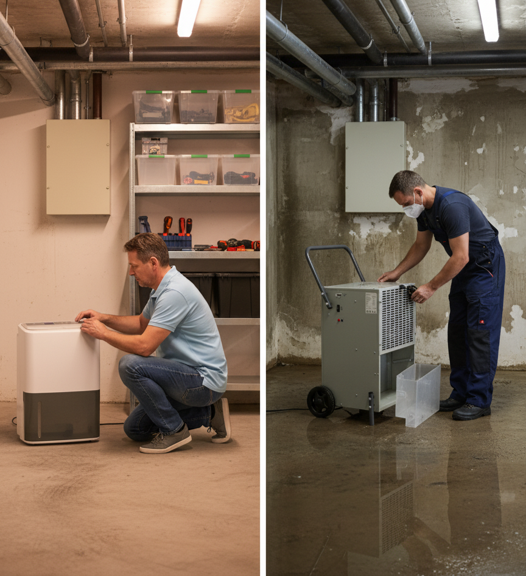
Water damage - dehumidifiers and building dryers
Dealing with flood damage: What you can manage yourself and when you should call in a professional
Updated on 19.12.2025

Reader time 2 minutes
✅ Water damage that you can usually fix yourself
If the flooding is minor and localised, homeowners can often manage the clean-up with dehumidifiers, fans and good ventilation.
Examples include:
- Small leaks or spills from household appliances (washing machine, water heater, dishwasher).
- Minor ingress of rainwater through windows or doors during a storm.
- A single room with shallow, clean water that drains quickly (e.g. a few centimetres).
- Flooding from clean water sources (e.g. a burst cold water pipe, not sewage).
- Floors and walls are largely non-porous (e.g. tiles, concrete) and no insulation is soaked.
👉 In these cases:
1. Remove standing water with mops, wet/dry vacuum cleaners or pumps.
2. Run dehumidifiers and fans continuously to dry the area.
3. Disinfect affected surfaces to prevent mould growth.
4. monitor humidity with a hygrometer to keep it below 60%.
If drying is effective within 24 to 48 hours, serious mould problems can often be avoided.
🔎Here you will find our top dehumidifier model for rooms up to 50 m² - WDU-725DG 🔎You can find our hygrometer here - WDH-TH205 🔎Here you will find a floor fan that supports the drying process - WDH-FF60M
When the problem is too big for DIY enthusiasts
Certain situations go beyond the scope of standard household appliances and require professional water damage restoration services:
- Large-scale flooding affecting multiple rooms, floors or the entire basement.
- Contaminated water (e.g. sewage, rainwater, river flooding) that contains pathogens and requires special disinfection.
- Water trapped in walls, insulation or under floors where mould can grow unnoticed.
- Prolonged contact (standing water for more than 48 hours).
- Electrical hazards, such as submerged electrical outlets or wiring.
- Structural damage - warped floors, cracked walls, sagging ceilings or damaged foundations.
- If visible mould appears after initial drying or strong musty odours persist.
👉 Professionals use industrial dehumidifiers, moisture meters and thermal imaging cameras to detect hidden moisture and prevent long-term damage that is not initially obvious.
🔎This is one of our basic models for industrial building dryers WDH-35B.📝 Rule of thumb
-
Small, clean water damage of short duration → DIY is often safe and effective.
-
Large, contaminated or hidden water damage → Call in professionals immediately.
⚠️ One final tip Even after minor flooding it is advisable to monitor the humidity and the walls for several weeksas some moisture problems only develop slowly. A dehumidifier is an excellent preventative measure, but is no substitute for professional remediation if the water damage is extensive or contaminated.
🔎You can find our material moisture analyser here - WDH-318KC to the blog index