


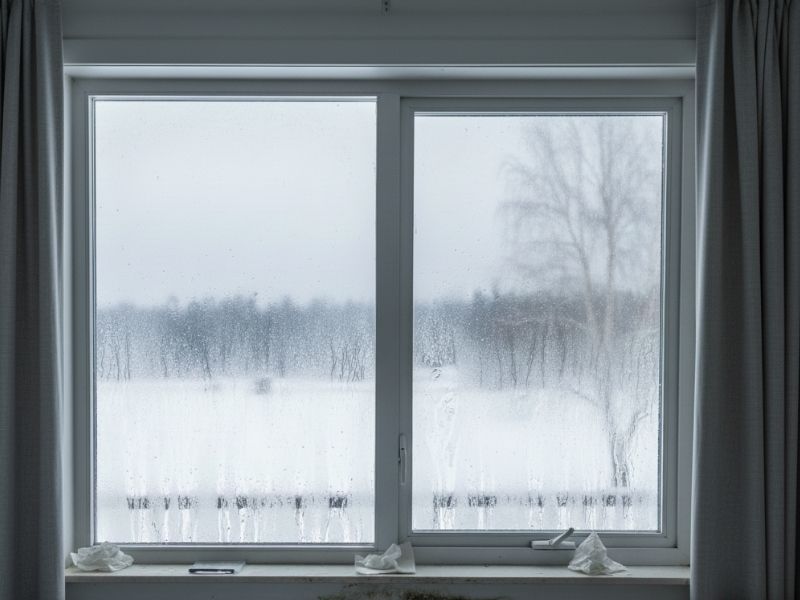
 Regulating humidity in the bedroom during the winter months
Winter problem: wet windows every morning - despite ventilation!
Updated on 30.12.2025

 Reading time 1.5 minutes
Less ventilation in winter - tighter windows
People automatically ventilate less often in winter. Nobody wants to let cold air into their home or heat it unnecessarily. At the same time, modern windows are significantly more airtight than older models. This makes sense from an energy point of view, but it also means that
Moisture can no longer escape unnoticed - it stays in the room.
Why in the bedroom in particular?
The bedroom is particularly susceptible to high humidity. There are two main reasons for this:
-
The room temperature is usually lower than in other living spaces.
-
Cooler air can store less moisture - the relative humidity rises more quickly.
As less heated bedrooms become potential condensation points, it is important not to heat these rooms with warmer air from heated areas. The warm air flows in with a higher moisture content and comes into contact with cold surfaces in walls and windows, where it reaches the dew point and condenses (invisible moisture becomes visible wetness), probably during the coldest part of the night.
This alone could explain why windows are often heavily steamed up or even wet in the morning.
Even if this is not the case, there is still the moisture that we produce ourselves: Just by breathing while we sleep, a noticeable amount of water vapour is released into the room air overnight.
Other sources of moisture in everyday life
In addition to sleeping, other sources of moisture are created every day, for example through
-
Showering and bathing
-
Cooking
-
Drying laundry in the home
-
Indoor plants
In well-insulated homes, this moisture quickly adds up - especially if the air is not exchanged regularly.
What helps first? Ventilate properly
The most important first step is short, frequent airing:
- In the morning, after getting up
- Before going to bed: If the bedroom has not been used or heated during the day.
- If possible, open the windows fully for a few minutes several times a day. This effectively exchanges humid air for drier outside air - even in winter.
When ventilation is not enough
 In some situations, ventilation alone is not enough, for example
-
in very well insulated homes
-
in bedrooms with a low temperature
-
if windows remain closed at night
In these cases, a quiet dehumidifier, such as our WDH-214US, can be useful. It helps to constantly lower the humidity without disturbing your sleep, thus reducing condensation on windows and the risk of mould growth.
Conclusion
Wet windows in the morning are not a sign of incorrect ventilation, but an indication of an imbalance between humidity and air exchange. If you understand the causes, you can take targeted countermeasures - with better ventilation and, if necessary, with technical support.
Further reading: Quiet dehumidifier: The ultimate guide to low-noise dehumidification
Further reference material from the Federal Environment Agency: Guide:Mould in the home (page 23:: Unheated or poorly heated rooms)